
The Donkey in Ancient Egypt: Laboring Companion and Symbolic Figure
Cécile BoudonThis article is a reworked translation of the essay by Luka-the-Pooka
Egyptian name: Aa-hemet or Eeyore
The donkey, domesticated by the Egyptians over 5,000 years ago, descends from the African wild ass (Equus africanus). At that time, it measured approximately 1.20 meters at the withers and weighed nearly 270 kg, significantly more than modern donkeys. Its robustness made it a cornerstone of terrestrial transport, long before the introduction of the camel.
A central role in daily life
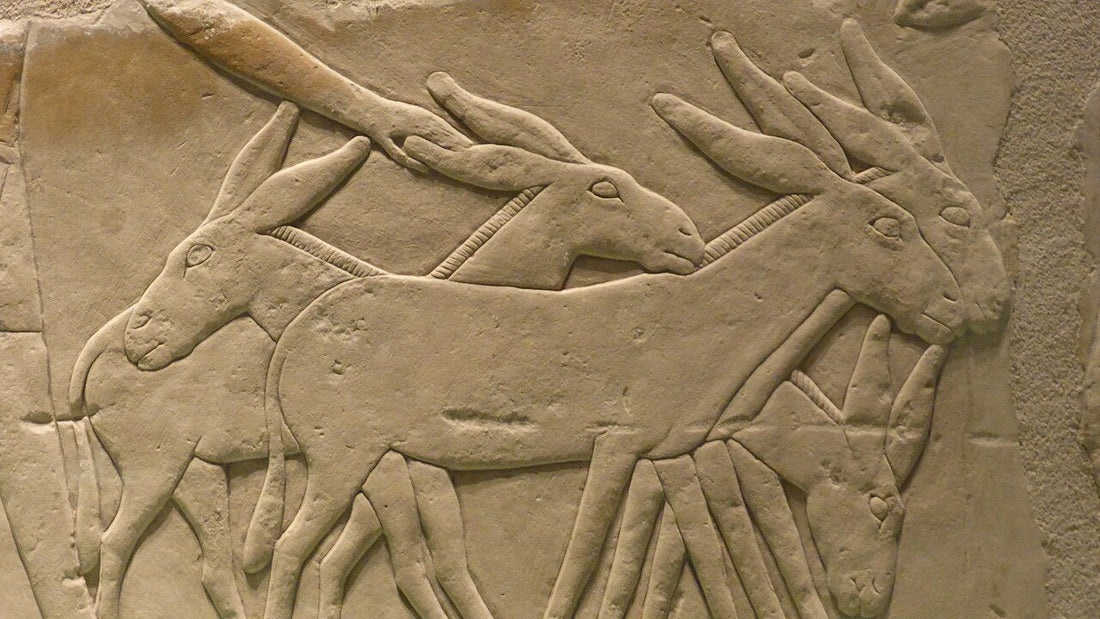
In the Nile Valley, donkeys were the primary beasts of burden. They transported merchandise, pulled carts, and participated in agricultural work. They were raised in herds supervised by keepers, or in enclosures. Tombs from the Old Kingdom often depict them loaded with sacks of grain or harnessed to chariots.
Female donkeys were sometimes used as dairy animals, and their milk was used to feed children or for medicinal purposes. Like pigs and cattle, donkeys were also employed for threshing grain, their hooves being particularly effective for this task. Some texts from the New Kingdom even mention donkeys harnessed to chariots, a rare but revealing image of their versatility.
 Ancient Egyptians controlled donkeys using sticks, or by holding them by the ear or tail. Bridles were only used after the introduction of the horse.
The donkey, an undignified mount?
Three bas-reliefs from the Old Kingdom show a owner transported in a palanquin suspended on two donkeys, a way to avoid mounting the animal directly. Indeed, riding a donkey was considered undignified, unless one was carried in a litter.
A precious and respected animal
The price of a donkey was high: it was worth more than a sheep, a goat, or a pig, and nearly as much as a cow. No distinction was made between males and females, and its value depended on the age and quality of the animal. Only wealthy owners could afford to own one; peasants often had to rent them.
Some owners boasted about their herds of donkeys, and the pharaohs themselves considered them worthy companions for the afterlife. The pharaoh Aha was buried with ten mummified donkeys, each placed in an individual tomb, at the same rank as high officials. The pharaoh Den, for his part, was accompanied by three mummified donkeys, placed upright, ready to follow him to the afterlife.

The remains of mummified donkeys, ready to follow their masters to the afterlife.
Donkeys with names and stories
A man named Sennefer left a touching trace: he had given names to his donkeys and recorded their lineage. These names, often funny or poetic, reflected their character:
Tamytiqeret ("Excellent cat"), daughter of Kyiry ("Companion")
Paounsou ("The howler"), son of Tamytiqeret
Pasaiou ("The pig grunter"), son of Pasab ("Jackal")
Paankh ("Living goat"), son of Pakheny ("Strong rower")
Paiou ("The one who looks like a dog"), son of Ramessou ("The Ramesses", named after the king himself)
The donkey in Egyptian proverbs
The donkey was also a source of inspiration for Egyptian proverbs, often tinged with humor or common sense:
"Do not tie your donkey's foot to the palm tree, for fear it will shake it."
"The hiss of the serpent is more effective than the bray of the donkey."
"If a donkey walks with a horse, it adopts his gait."
"One does not praise a donkey carrying a load because it brays."
"When there is work, take a donkey. When there is fodder, go find an ox."
An ambivalent figure in mythology
From the Middle Kingdom onwards, the donkey was associated with the evil god Seth, who sometimes took the form of a red donkey. A legend recounts that 77 donkeys attempted to prevent the sunrise, opposing the sun god Rê.
During the New Kingdom, the "donkey of Seth" was ritually sacrificed during the festival of Osiris. At Busiris, the sacrifice was symbolic: the image of a donkey was printed on sacrificial bread. The hieroglyph representing the donkey was sometimes bound or pierced with a knife, to render it harmless.
 Hieroglyph representing a donkey pierced with a knife, to render it harmless.